Qing Wu is a Chinese teacher whose real-life experience, observations, and teachings shape the Old Master series. This site brings his knowledge to English-speaking readers through a curated knowledge base and an AI-assisted digital counterpart.
Brush & ink
Words, written by hand.
Qing Wu at his writing desk.
A brush waits above the paper. Beside it are an inkstone, a rack of brushes, and a page of poetry.
These photographs show Qing Wu himself. The calligraphy on this page is his own handwriting, copying classical poems.
Here are three short poems copied in ink. Each can be opened for a closer look, with an English rendering alongside it.
Alone, I sit in a quiet bamboo grove. I play my zither and let out a long whistle. No one in the deep woods knows I am here. The bright moon comes to shine on me.
An English rendering for this page. The calligraphy copies Wang Wei's poem.
Two more poems, and a look around the room
River Snow Liu ZongyuanSeeking the Hermit Jia DaoThe writing room Paper, brushes, and daylight.
The Old Master series
Two books. Two ways in.
Begin with a question for the Changes, or explore the Four Pillars of a birth chart.
Book One · The I Ching
The Old Master's Guide to the I Ching
How to ask the Changes a question, work with its images, and read an answer with care.
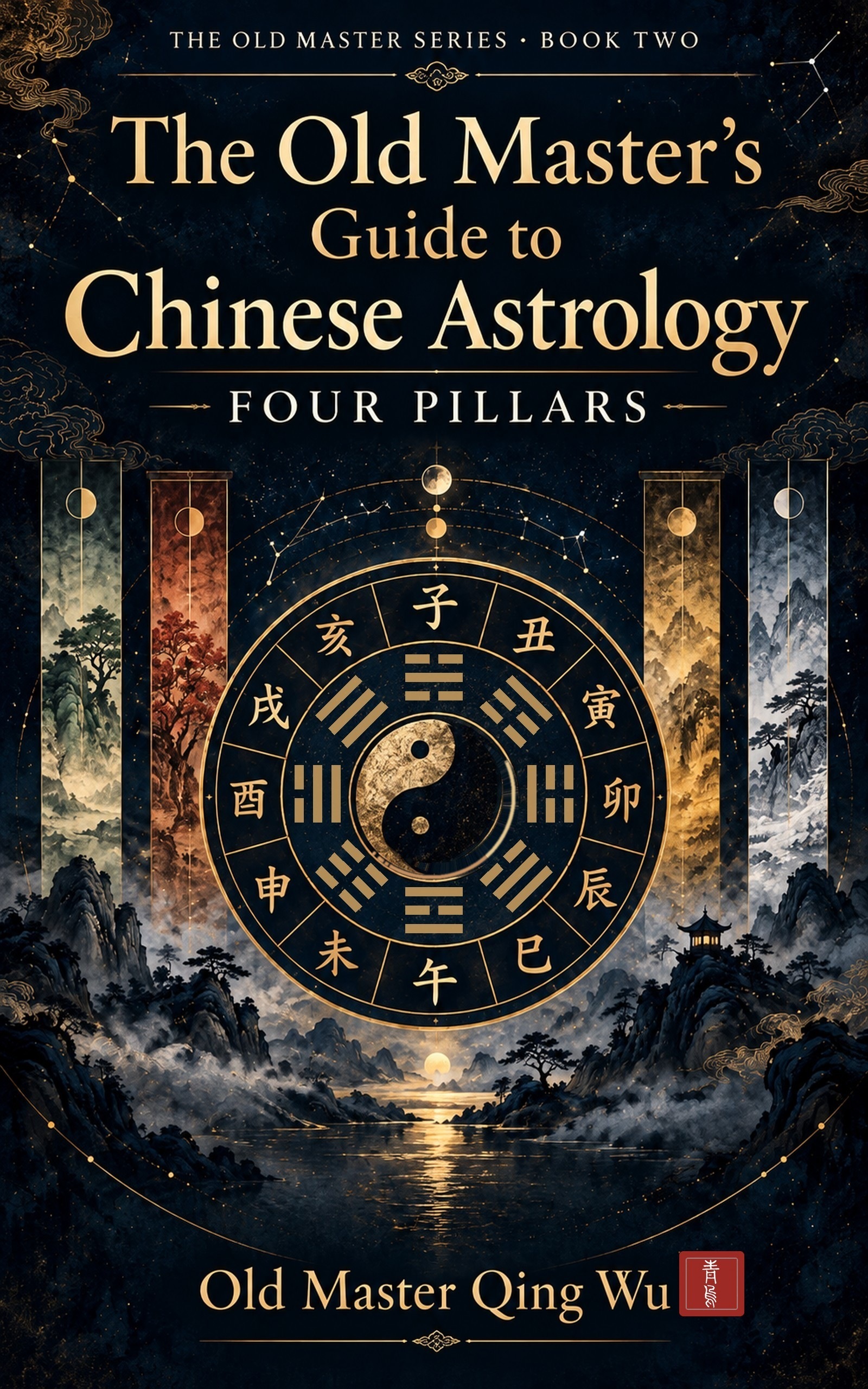
A companion for readers exploring BaZi: the four pillars, their relationships, and the questions to bring to a chart.
Amazon listing under review.
How the desk works
Texts, calculations, and an AI voice.
The site brings curated notes and classical references together with calculated chart evidence and AI-assisted explanations. A source reference helps you follow the basis of a reading; it does not prove a prediction or mean every sentence is a quotation.
Qing Wu teaches in Chinese. His knowledge and reference materials are organized into a knowledge base, and AI helps present them in English. The digital counterpart can summarize and explain these materials; its replies are AI-assisted interpretations rather than Qing Wu's exact words.
A note on Qing Wu and the stories in the books
These books draw on the real-life experience, observations, and teachings of Qing Wu, a Chinese teacher whose voice and perspective shape the Old Master series.
The first-person narration reflects his perspective, but these books are not intended as verbatim autobiographies or transcripts. To make the teachings accessible and the stories more complete and engaging, some accounts have been retold or artistically adapted. Some cases are drawn from individual experiences; others combine elements from multiple real-life cases or reconstruct situations for teaching purposes. Dialogue, identifying details, chronology, and other circumstances may have been adjusted.
The aim is to preserve the substance of the experience and the wisdom behind it while presenting the material in a form that readers can follow and understand. The stories should therefore not all be taken as literal records of a single event or person.
The classical texts and historical sources cited in these books are separate from the illustrative narratives and can be consulted independently.
The Day Master is the stem in the Day pillar of a BaZi chart. It is a reference point for the method, not a complete portrait of a person.
The project bilingual glossary lists Day Master among four core BaZi concepts. This is a project reference note, not a quotation attributed to an ancient book.
Where the AI sits
An AI model may summarize or connect curated notes, source references, and calculated evidence. This is an AI-assisted interpretation, not a guarantee that every statement comes directly from a cited page.
For readers 18 and up. Readings offer cultural perspectives for entertainment and self-reflection, not medical, legal, or financial advice.